Most family emergency plans have a single point of failure: everyone’s phone. In a real disaster, cell networks get congested or lose power, and “just call me” stops working exactly when you need it most. The fix isn’t complicated — it’s redundancy: a few simple, layered ways to reach each other and stay informed.
Have multiple ways to stay informed and in touch, so that when one system fails, another still works. Write the plan down. A plan only helps if everyone knows it.
Step 1: an out-of-area contact
Pick one relative or friend who lives in another city or state to be your family’s check-in hub. After a local disaster, long-distance texts often go through when local calls won’t, and it’s easier for everyone to report to one out-of-area person than to reach each other directly. Make sure every family member has that number memorized or written down.
Step 2: meeting places
Agree on two spots: one just outside your home (for a house fire), and one outside your neighborhood (if you can’t get back home). Kids especially need to know exactly where to go if phones are down.
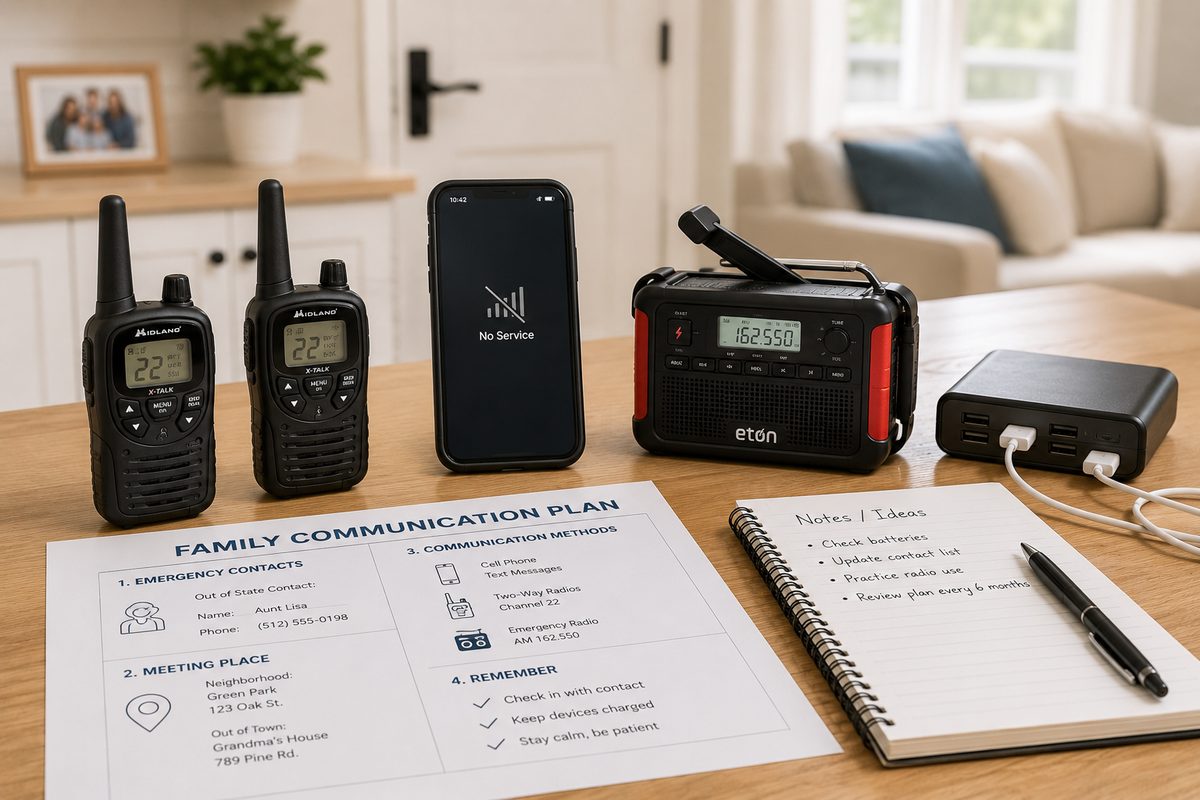
Step 3: layer your communication tools
Think of it as concentric circles, from “just us” to “the wider world”:
- Text & data — still try first; texts are lightweight and often work when calls don’t.
- Two-way radios — for keeping a family together over short distances (around the neighborhood, a campsite, a store). FRS walkie-talkies are license-free; GMRS radios reach farther but need a simple FCC license (see below).
- A NOAA weather radio — one-way, but it keeps you informed when everything else is down. Weather alerts broadcast on dedicated frequencies (162.400–162.550 MHz).
- Ham radio — the deepest layer, able to reach across town or across the country when infrastructure is gone. It requires a license and a little learning — start with our ham radio basics guide.
FRS (most blister-pack walkie-talkies): no license, low power, short range. GMRS: one $35 FCC license covers your whole family for 10 years, no exam, and allows higher power and repeaters. Ham (amateur radio): requires passing a license exam, but offers the most range and capability.
Step 4: keep devices charged
A communication plan dies with a dead battery. Keep a charged power bank in your kit, and consider a power station for longer outages. “Charged, connected, prepared” is the whole game.
Gear to make it real
Heads up: the gear links below are affiliate links. If you buy through them we may earn a small commission, at no extra cost to you. We only suggest gear we'd actually use. Full disclosure.
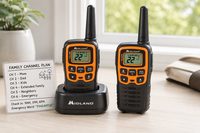 Two-way radios (FRS/GMRS) Simple radios for neighborhood, campground, store, and short-range family coordination. See current price
 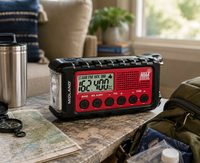 NOAA weather alert radio No license needed — a reliable way to hear weather alerts when phones are unreliable. See current price
 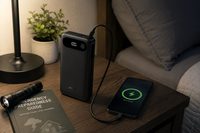 USB-C power bank The small, cheap battery every go bag and car kit should have before a larger power station. See current price
 Write it on one page
The most powerful tool here isn’t a radio — it’s a single printed page on the fridge with your contacts, meeting places, and which device to use. Fill one out, practice it once, and review it every six months. That’s a family communication plan. Calm, simple, and ready.